lunes, 19 de noviembre de 2012


miércoles, 21 de diciembre de 2011
La revolución será feminista o NO será
Las mujeres egipcias marchan contra los abusos de las fuerzas de seguridad
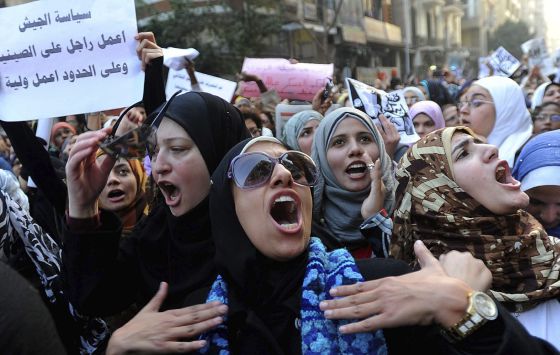
Mujeres egipcias participan en la manifestación convocada para pedir que se respeten sus derechos, hoy en El Cairo / MOHAMED OMAR (EFE)
“Libertad, libertad, libertad!”. Las voces femeninas se han alzado hoy sobre las de los hombres y acompañadas por ellos en un grito que resuena contra los muros de hormigón que aíslan Tahrir, y la voz de los manifestantes, del Parlamento, el ministerio del Interior y los oídos de los soldados que aguardan pertrechados detrás. Ya son al menos 14 los muertos (muchos por disparos en la cabeza y el pecho) y más de 500 los heridos en las últimas cinco jornadas de enfrentamientos. Los militares, ayudados ahora por la policía, esperan a que caiga la noche para empezar a intercambiar con los manifestantes piedras y bombas incendiarias. Los últimos tres días, han intentado romper la sentada que día y noche sigue en la plaza Tahrir poco antes del amanecer. Después, vuelven a sus barricadas. El Consejo Supremo de las Fuerzas Armadas ha manifestado en una nota publicada en Facebook que lamenta "profundamente" los ataques contra las mujeres y ha instado a "todos" a rechazar la violencia para encontrar a los "matones" que quieren dañar a la revolución.
Sin embargo eso no ha amedrentado al millar de mujeres que han marchado hoy hasta el último muro de hormigón levantado por los soldados egipcios que reprimen su protesta contra el gobierno militar. El pasado viernes la imagen de una mujer velada a la que se había golpeado brutalmente y arrancado la ropa ocupó las portadas de los medios de todo el mundo. Hoy esa imagen, impresa en un cartel y con la leyenda “Un Egipto sin dignidad es un Egipto sin vida”, presidía la marcha de mujeres. “Ella es sólo un símbolo de lo que lo militares hacen con los manifestantes y con las mujeres que acudimos a protestar, especialmente”, señala Dina, una piloto en paro que ha pasado el último mes acampando frente al Parlamento, hasta que la desalojaron “a golpes”. “Me han insultado, me han dicho que me iban a violar y que si quería salvar la vida era mejor que me fuera casa”, explica esta mujer de 27 años. “Que nosotras estemos aquí desmonta su intento de hacer creer a la gente que los que hay aquí son asesinos pagados por extranjeros, por eso quieren humillarnos”.
También la Secretaria de Estado estadounidense, cuyo Gobierno daba ayer un toque de atención a la Junta militar que gobierna Egipto condenando la violencia, se ha referido a la citada imagen: “Esta degradación sistemática de las mujeres egipcias deshonra la revolución, avergüenza al Estado y su uniforme y no es digna de un gran pueblo”, ha señalado hoy la secretaria de Estado, Hillary Clinton, en un discurso en la Universidad de Georgetown, en Washington.
Aumentan las agresiones
“Las mujeres hemos sido parte de esta revolución desde el 25 de enero”, argumenta Sheriin, una especialista en desarrollo de cuestiones de género e igualdad, mientras trata de hacerse oír entre los gritos de las mujeres que gritan junto a ella. “Estar aquí es un gran paso. Debemos aprovechar cada oportunidad que tengamos para recordar que somos fuertes, que somos iguales y que no tenemos miedo”. El 83% de las egipcias y el 98% de las extranjeras que residen en Egipto sufren a diario algún tipo de acoso sexual. “Ella es el símbolo de esa represión que sufrimos a diario”, apunta.
Desde el inicio de la última ola de protestas hace casi un mes, los casos de agresiones a mujeres manifestantes se han repetido por parte de la policía militar que ya las golpeaba o pisoteaba como al resto de participantes en las protestas. La bloguera y periodista Mona Eltahawy narró en la red social Twitter su agresión poco después de pasar 12 horas retenida en el ministerio del Interior: “Me rodearon 5 ó 6, me tocaron y pellizcaron los pechos y me agarraron los genitales. Perdí la cuenta de cuantas manos intentaron meterse en mis pantalones”. Esa violencia sexual es una práctica de tortura que se emplea tanto contra hombres como mujeres en Egipto, según ha constatado el Centro Nadeem para la Tortura, pero parece que ahora también ha llegado a las calles.
“Golpeadme, desnudadme, pero no veréis el miedo en mis ojos”, grita junto a Sheriin una mujer madura con su hijo adolescente al lado. Más allá, un par de adolescentes con los libros bajo el brazo alzan el puño y exclaman: “Las egipcias hemos hablado, el mariscal [Tantaui] está bajo nuestro zapato”. “Debemos luchar para conseguir nuestros derechos. No venimos como acompañantes, sino a dar nuestras vidas igual que ellos”, clama Dina.
martes, 14 de septiembre de 2010
Secretary-General’s Press Encounter, Announcing Ms. Michelle Bachelet as Head of UN Women
[Unofficial transcript. Reprinted from the UN Secretary-General's off-the-cuff remarks to the press and the public. Watch the webcast.]
SG: Good morning Ladies and Gentlemen,
Thank you for coming at such short notice.
Today, I am delighted to announce the appointment of Ms. Michelle Bachelet, former President of Chile, as the head of UN Women, the newly created UN Entity for Gender Equality and the Empowerment of Women, established on 2 July by the General Assembly Resolution.
As you know, the creation of UN Women is the culmination of almost four years effort and today’s announcement has been made possible thanks to the hard work of the Member States and the many partners who share our commitment to this agenda.
This has been a top and very personal priority of mine and I therefore take special satisfaction in this appointment. Nearly four years ago, I took office determined to see the merging of the four separate gender entities into one powerful, dynamic and effective entity. UN Women will promote the interests of women and girls across the globe.
Ms. Bachelet brings to this critical position a history of dynamic global leadership, highly honed political skills and uncommon ability to create consensus and focus among UN Agencies and many partners in both the public and private sector.
I am confident that under her strong leadership, we can improve the lives of millions of women and girls throughout the world.
Next week, we will host a special summit on the Millennium Development Goals. Women and children will be at the very core of our final push to realise the goals by the deadline of 2015.
Thank you very much.
Q: Mr. Secretary-General, can you tell us more about the process leading up to the appointment of Michelle Bachelet? There were some rumours that she didn’t want the position, and then changed her mind. And then also, can you talk a little bit more about what you hope she can accomplish in the immediate term?
SG: First of all, this process started as soon as the General Assembly adopted the Resolution, asking me to appoint the head and establish this organization.
We opened this process to the Member States and all NGOs and the civil community. We have received 26 distinguished candidates from all around the world. We have constituted a selection panel headed by the Deputy Secretary-General, Dr. [Asha Rose] Migiro, and also composed of senior advisors – Under-Secretaries-General, and also outside panel members. The process has been very transparent, and very objective, and fair.
As a result of this selection process, I was recommended to interview myself three finalist candidates, whose names I am not going to announce for their privacy. I have interviewed them personally last week, and I decided with the unanimous consent of all the panel members. I am very pleased that former President Michelle Bachelet will bring a wealth of experience, global leadership, and global stature, in first of all establishing this new UN Women entity, and bring to it a real force to meet the expectation of many women and girls and children around the world. I am sure that under her strong leadership we will have a very strong new UN Women entity.
The General Assembly asked me that this new agency should be fully operational by 1 January 2011, next year. We have a little more than three and a half months. I will discuss this Sunday, when I appoint her formally, how we can make the process very speedy, so that we can appoint and recruit staff and we have to have our agendas. Basically we have all these structures in place. Now it is a matter of how we can speedily implement these structures and policy and visions.
I will do my best, working closely with Ms. Bachelet, to make this entity fully operational as soon as possible, meeting the expectation of so many millions and millions of women and girls around the world. I ask all the Member States and civil community leaders, and governments, and business communities, to render their full support and cooperation.
Thank you very much.
miércoles, 10 de marzo de 2010
Estados Unidos ante la equidad de género en la arena internacional
You mentioned that International Women’s Day started in Copenhagen, it actually started right here in New York City, it was a group of –prior to 1910- it was a group of activist women liberals in New York City who were challenging the fact that women in sweat shops used to be locked up in those sweat shops and because the Socialist movement met that workers struggle and, of course, United States essentially shut down any recognition of its own history… most Americans have not idea of what International Women’s day is although I grew up in India celebrating and singing songs in praise of the brave women workers in New York. Kavita Ramdas Global Fund for Women
Ver las expresiones completas de Ramdas aquí
sábado, 20 de febrero de 2010
Las mujeres alimentan al mundo
México D.F., 18 de febrero (apro).- En el mundo pobre existe una emergencia, se llama crisis alimentaria. Según datos del Fondo de las Naciones Unidas para la Alimentación (FAO) mil 020 millones de personas están mal nutridas en el mundo, es decir; una de cada 6 de todas las que habitan el planeta. Y pueden llegar a ser mil 500 millones en 2015 si no se hace algo y pronto.
Esta crisis hace visible la pobreza rural, que representa el 75% de toda la pobreza del mundo y está íntimamente ligada a la depredación de los bienes del planeta que nos está cambiando el clima, las corrientes de los ríos y el calado de los vientos.
Como nunca había sucedido, en febrero llueve en Barcelona y el frío hiela los huesos; nevó exageradamente en Berlín; la lluvia que afectó al Distrito Federal y a la zona conurbada de la ciudad de México son pruebas de este abuso que los humanos han hecho del planeta.
Lo más grave es que todavía son principalmente las mujeres las que alimentan al mundo, son ellas las que aseguran que no falte el arroz en el sudeste asiático y ellas las que producen trigo y maíz en América, que proporciona hasta el 90% de los alimentos que consume la población empobrecida de las zonas rurales.
En la África subsahariana las mujeres producen hasta el 80% de los alimentos básicos para el consumo familiar y su venta, ellas cultivan hasta 120 especies vegetales diferentes en los espacios libres junto a los cultivos comerciales de los hombres.
Es decir, estos datos, de un libro que se llama “Las Mujeres Alimentan el Mundo” que editó una organización no gubernamental de Barcelona, llamada Entre Pueblos, revela que el agotamiento del planeta, que se viene, la falta de agua y todo lo que ello significa, pasará por arrasar la vida de millones de mujeres, ellas, mil 600 millones que en el mundo están produciendo alimentos.
Lo más grave, según el artículo de Alex Gillamón, coordinador de esa organización, es que los alimentos son un negocio de empresas que están en todo el mundo haciendo de las suyas, controlando el mercado, los suelos, la agroalimentación, especulando con los granos y para no arriesgar sus ganancias, expulsan a los campesinos y a sus familias de las regiones ricas y productivas.
El agua se acaba mientras que el número de víctimas del hambre es mayor que nunca.
Leer esas cifras, en el contexto de testimonios de mujeres que se organizan por todo el mundo, en una red llamada Vía Campesina, me puso a pensar al menos dos veces en cuánto sabe la opinión pública de este asunto, cuánto se valora que sean las mujeres –muchas esposas de los que migran- quienes son las conservadoras de algunas tradiciones del cuidado del campo y guarda de semillas, quienes calladamente o haciendo alharaca, se oponen a los transgénicos y procuran, con su sabiduría, conservar amplias zonas del planeta.
Es curioso, en el libro referido hay historias completas de cómo se organizan las mujeres en Guatemala, Colombia y México, narra la falta de tierra para las mujeres, de cómo las temporaleras carecen de seguridad social; sin embargo, es un libro de esperanza al describir las estrategias para rescatar las tierras que ellas proponen; rescata las viejas sabidurías populares que permiten producir alimentos para pueblos enteros que hoy podrían desaparecer.
Una estrategia que ha llamado soberanía alimentaria.
La publicación que podría estar disponible en la internet, es un ejemplo de cómo se elaboran propuestas desde la sociedad civil para salvarnos de las políticas que desde el poder se imponen para sólo acumular dinero y apoyar a los grandes capitales; un ejemplo de que a pesar de los perseguidos por defender su tierra, como Ignacio del Valle en Atenco, todavía hay voces que no se derrotan y acciones que se mantienen.
Es así como las voces de las mujeres trascienden todas las fronteras y existen, en los lugares menos imaginados, testimonios de que la población resiste a quienes generan políticas de exterminio humano y demolición de las ideas.
Esta organización no gubernamental, Entre Pueblos, se dedica a reunir estas voces, no sólo en documentos o en un libro, sino que desde Cataluña, acompaña a estos grupos de hombres y mujeres que resisten los embates del capitalismo salvaje en muchos lugares del mundo, pero especialmente en América Latina.
Habría que preguntarse, en todo caso, si quienes toman decisiones o despliegan propuestas para recomponer esta crisis, escuchan o no estas voces que se van extendiendo por todas partes, advirtiendo que ya no hay forma de salvar al mundo con un sistema que sólo piensa en el dinero y no en las personas; en el poder y no en la humanidad; en la acumulación material y no en el horizonte de la vida, que se encuentra en la riqueza de las voces, en las miradas y las creaciones artísticas, en la generosidad y no en el militarismo.
saralovera@yahoo.com.mx
Enlace original.
lunes, 7 de diciembre de 2009
Hace veinte años: Masacre de odio en Montreal
Ver video sobre la noticia aquí
Entre los artículos y ensayos que he leído por el tema (gracias, Aníbal), destaco este fragmento:
I still maintain that the absence of relationships with women should be considered a major warning sign that a man is capable of mass homocide or femicide. It’s such an obvious commonality of all of these North American massacres–from Montreal, to V-Tech, to Fort Hood. But, because misogyny is normalized, and the degradation of women is a substantial part of our entertainment and political culture, guys like this get a pass until they start shooting. We mourn the victims, but we don’t take meaningful steps to prevent the creation of other victims. There’s no political advantage in reducing even mentally ill and socially maladjusted men’s Second Amendment rights.[Enfasis nuestro] (Ann M. Little a.k.a. Historiann en su blog)
PrOhIbIdO OlViDaR
miércoles, 12 de agosto de 2009
Violencia Sexual en el Congo (¡¡¡terrible!!!)
Clinton Presents Plan to Fight Sexual Violence in Congo
By JEFFREY GETTLEMAN
GOMA, Congo — Secretary of State Hillary Rodham Clinton came face to face with the consequences of the brutality in eastern Congo on Tuesday afternoon when she met a Congolese woman who had been gang-raped while she was eight months pregnant.
The fetus died, Mrs. Clinton said, the woman was gravely injured and since there was no hospital nearby, villagers stuffed the woman’s wound with grass to keep her from bleeding to death.
“I’ve been in a lot of very difficult and terrible settings,” Mrs. Clinton said later. “And I was just overwhelmed by what I saw.”
“It is almost impossible to describe the level of suffering,” she said. Eastern Congo’s rape epidemic, she added, “is just horrific.”
Mrs. Clinton used her unprecedented visit — she is the first secretary of state to venture into the war zone here — to unveil a $17 million plan to fight Congo’s stunning levels of sexual violence, a problem she called “evil in its basest form.”
She announced that the American government would train doctors, supply rape victims with video cameras to document violence, send American military engineers to help build facilities and train Congolese police officers, especially female police officers, to crack down on rapists.
“This problem is too big for one country to solve alone,” Mrs. Clinton said after meeting with Congo’s president, Joseph Kabila. Her visit was part of a seven-nation Africa tour intended to strengthen relations with strategic African countries and to use American influence to stop Africa’s wars. She arrived Tuesday night in Abuja, Nigeria, and planned talks Wednesday with Nigerian officials.
Eastern Congo is home to the worst war on the continent right now, an intensely predatory conflict driven by a mix of ethnic, commercial, nationalist and criminal interests, in which various armed groups often vent their rage against women. The United Nations calls Congo the rape capital of the world and says hundreds of thousands of women have been raped in the past decade. Nothing so far — not 18,000 peacekeepers, not various regional peace treaties, not other high-level diplomatic visits — have stemmed the violence.
Recent Congo-Rwanda military operations along the volatile border may be making things worse. The operations have spawned revenge attacks that have driven more than 500,000 people from their homes. Dozens of villages of have been burned. Hundreds of villagers have been massacred. And countless women, and recently many men, have been raped. Often the rapists are Congolese soldiers.
Mrs. Clinton said she urged the Congolese government to do a better job of protecting its own people and to prosecute offenders in the Congolese military, which is notorious as one of the least disciplined, poorest paid armies anywhere.
“I spoke at length with President Kabila about the steps needed to be taken to protect civilians,” she said. “We believe there should be no impunity for the sexual and gender based violence, and there must be arrests and punishment because that runs counter to peace.”
Mrs. Clinton also addressed some of the conflict’s root causes, including Congo’s illicit mineral trade. In the words of Congo’s foreign minister, who also met with Mrs. Clinton on Tuesday, the country, with its rich trove of diamonds, gold, copper, tin, coltan and other minerals, is a “geological scandal.”
But Congo’s mines are often the unlawful prize of armed groups, and Mrs. Clinton said the world needed to take more steps to regulate the mineral trade to make sure the profits do not end up “in the hands of those who fuel the violence.”
After the official meetings, Mrs. Clinton and her heavily guarded entourage toured a refugee camp on the outskirts of Goma where 18,000 people are camped out on a field of volcanic rock. One of the first people she met was an aid worker who rattled off the problems: malaria, diarrhea, hunger, difficulties breathing because of all the dust, and of course, constant insecurity. The aid worker told Mrs. Clinton that an 8-year-old boy who had strayed out of the camp was raped the other day.
“Really?” Mrs. Clinton asked.
“Really,” he answered.
Then she met Chantal Mapendo, mother of six, who stepped forward from the corridors of long drawn faces that had instantly formed to look at the important white lady with all the sunglassed security guards. Mrs. Clinton visited the camp for 20 minutes. Mrs. Mapendo, whose home area has been plagued by fighting, has been living here for three years.
“Our life is very bad,” Mrs. Mapendo said. “We get raped when we go out and look for food. We want to leave this place and go home.”
Mrs. Clinton nodded. “Thank you for talking with me,” she replied. “I just met with President Kabila and told him we want to help you return home.”
After the camp, she spoke with two rape survivors, including the woman who lost her fetus and nearly bled to death in the bush. Mrs. Clinton then talked with a group of doctors and advocates who specialize in treating victims of sexual violence. Many said they felt abandoned.
“Children are killed, women are raped and the world closes its eyes,” said one woman.
Another called Congo the “soft belly” of Africa, a huge, rugged place with a notoriously inept army that has become a magnet for all the rogue groups in Africa.
A third woman, Christine Schuler-DeSchryver, a well-known anti-rape activist, vented about all the empty promises from the stream of high-ranking visitors who have recently come to eastern Congo, “one more important than the next.”
“In the end, all we got was a pile of business cards,” she said.
She pressed Mrs. Clinton to do more to end the criminally-controlled mineral trade.
“Madame Secretary,” she said, “we want you to be our spokesperson, our voice.”
After five hours on the ground in Goma, Mrs. Clinton climbed back on the plane, this time bound for Nigeria. She seemed drained.
“It was an incredibly emotional experience,” she said.